Key Takeaways
- Superpower announced its Peptide Library on X on Monday, October 26, 2026, with 152 peptides.
- Digestive & weight is the largest of the library's eight body groups, with 35 entries, or 23% of the 152.
- The BPC-157 entry says 35 of the 36 studies in a 2025 systematic review were animal or lab work.
- An FDA briefing for the July 2026 advisory meeting proposed that BPC-157 not be included on the 503A Bulks List. Advisers voted 8-6, with one abstention, to recommend adding two peptides: BPC-157 for ulcerative colitis and KPV.
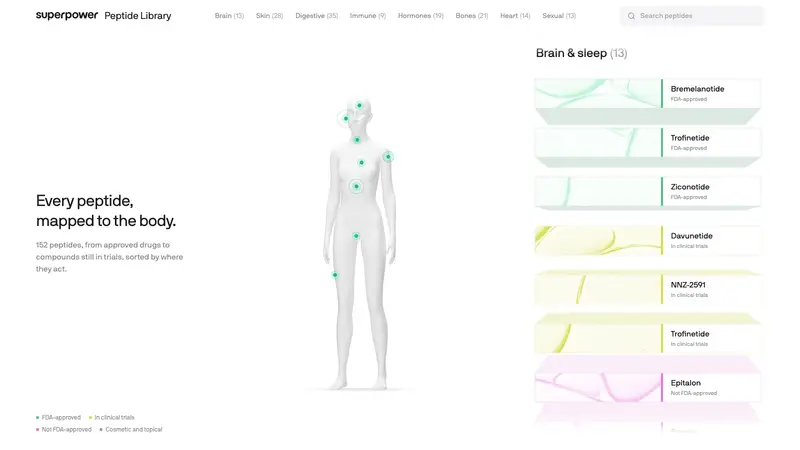
Superpower, a San Francisco health startup, announced a Peptide Library of 152 peptides in a post on X on Monday, October 26, 2026. The library runs from approved drugs to compounds still in trials.
The largest group is Digestive & weight, with 35 of the library's 152 entries, or 23%, by WYDE's arithmetic on the page's eight group counts. Semaglutide, sold as Ozempic and Wegovy, sits in that group.
Superpower, founded in early 2023, has raised $30 million in a Series A round, according to Athletech News. A Superpower post on X said semaglutide is FDA-approved and BPC-157 is not.
What the Peptide Library Lists and How Its Entries Are Dated
The eight body groups hold 152 entries: Brain & sleep 13, Skin & aging 28, Digestive & weight 35, Immune & defense 9, Hormones & metabolism 19, Bones & muscles 21, Heart & blood 14, and Sexual & reproductive 13. The legend lists four statuses: FDA-approved, In clinical trials, Not FDA-approved, and Cosmetic and topical. The page does not state how many entries carry each status.
Individual entries carry their own dates, and some predate the launch. The BPC-157 entry was published April 18, 2026, and last updated October 5, 2026. The semaglutide entry was published October 13, 2025. The BPC-157 entry names its reviewer as William Maish, MD MBA MPH, Clinical Product Lead, and says its peer-reviewed studies are cited by DOI where used.
BPC-157 Evidence: One Human Report in a Mostly Preclinical Review
The BPC-157 entry says the evidence is mostly preclinical. The figure below shows that entry as Superpower published it.

The review, Emerging Use of BPC-157 in Orthopaedic Sports Medicine: A Systematic Review, appeared in HSS Journal. Its authors searched PubMed, Cochrane and Embase through June 3, 2024, and identified 544 articles from 1993 to 2024. After duplicates were removed, 36 studies were included: 35 preclinical and one clinical.
The one human study was retrospective, meaning it looked back at past cases. It followed 12 patients with chronic knee pain who received an intraarticular injection, meaning an injection into a joint, of BPC-157. Seven of the 12, or 58%, reported relief lasting more than six months. The library adds that the report had no control group, effect size or safety data.
The review describes itself as a systematic review of level IV and level V studies. It concluded that those studies suggest BPC-157 shows promise for promoting recovery from musculoskeletal injuries. Preclinical safety studies showed no adverse effects across several organ systems, but the review found no clinical safety data. It warned that adverse effects are possible because of unregulated manufacturing, contamination or unknown clinical safety.
FDA's July 2026 Briefing and the Advisory Vote on BPC-157
The 503A Bulks List is FDA's list of ingredients that licensed pharmacies and physicians may use to compound drugs. The BPC-157 entry says FDA placed the peptide in Category 2, the category for substances that may present significant safety risks, in 2023 and removed it in April 2026 because the nominators withdrew their nominations. FDA's briefing document for the Pharmacy Compounding Advisory Committee meeting of July 23-24, 2026 confirms that the nomination was withdrawn by the nominator. It also says FDA chose to present the peptide anyway and proposed that both forms not be included on the 503A Bulks List.
RAPS reported that the committee voted 8-6, with one abstention, to recommend adding two peptides to the 503A Bulks List: BPC-157 for ulcerative colitis and KPV for wound treatment and inflammatory conditions. The library's entry says the committee voted in favor of allowing the peptide to be compounded and calls that vote a recommendation only. It does not give the 8-6 count or mention FDA's proposal against listing the peptide. FDA says it does not intend to issue a final determination until input from the advisory committee process has been considered and all reviews have been finalized.
Bill Zamboni, a committee member, said, "There are too many unknowns about this product." David Pope of XiFin Pharmacy Solutions, who voted yes, said, "I voted yes because it's time to put this decision back in the hands of the physician and pharmacist." RAPS reported both statements.
People Also Ask
Is BPC-157 FDA-approved?
No. Superpower's BPC-157 entry says BPC-157 is not FDA-approved for any indication. FDA's July 2026 briefing document proposed that BPC-157 not be included on the 503A Bulks List for compounding.
Is semaglutide FDA-approved?
Yes, for specific uses. Ozempic was approved for type 2 diabetes in 2017, as HealthDay reported. Wegovy was approved on June 4, 2021, for chronic weight management, according to FDA's announcement, reprinted by BioSpace.
How many studies in the BPC-157 review were animal or lab work?
The 2025 review included 36 studies, and 35 of them were preclinical. The BPC-157 entry describes those 35 as animal or lab work.
Sources: Superpower Peptide Library, Superpower BPC-157 entry, Superpower semaglutide entry, PubMed Central, FDA briefing document, FDA, RAPS, BioSpace, MedicalXpress, Athletech News.