
For most of history, doing good was expensive, and making money was how you paid for it. So the two came in order. First the fortune. Then, late in life, the giving. We called the second act philanthropy and treated it as the nobler one. We rarely asked why it had to come second.
The answer was arithmetic. Feeding people, curing people, teaching people, all of it cost money that had to be earned first, usually somewhere harsher. The gift at the end was part generosity and part apology.
Philanthropy used to mean making money first, then giving it away
The monuments still stand. Carnegie built 2,500 libraries, after steel and after he broke the Homestead strike. Rockefeller funded the labs that beat yellow fever, after regulators split up his monopoly. Gates drove measles and polio toward zero, after a decade as the most famous antitrust defendant in tech. The good was real. It was also built with the back half of a life, from a fortune the public had already judged.
A few saw it whole. George Cadbury, the Quaker chocolate maker, ran his business and his giving as one pattern, and built his workers an entire model town to prove the point. He was the exception that marked the rule. For everyone else, philanthropy was a correction applied after the fact. The pattern still runs today. The year's biggest gifts, Ken Griffin's record $3 billion to a university, Bill Ackman's $400 million brain institute, the $500 million Chan Zuckerberg Biohub, still arrive after the fortune, not inside it.
"Do no harm" and "don't be evil" were never really the goal
Look at the ethics we kept from that world. Medicine's famous line, first do no harm, is a floor, and it is not even in the Hippocratic Oath. Google's old motto, don't be evil, is a floor too. Both say what not to do. Neither asks for any good at all.
We mistook the floor for the ceiling, then lowered the floor. Google cut don't be evil from the front of its code of conduct in 2018, around the peak of its power. When the boldest promise a trillion dollar company will make is to avoid being evil, the word philanthropy has quietly left the room. A floor is not a purpose, and we spent a century pretending it was.
The future of philanthropy when building costs almost nothing
What breaks the old order is plain. Doing good is getting cheap. The cost of building has fallen for twenty years, and AI, whose buildout now nears $780 billion, just pushed it off a cliff.
- 1999. A startup paid millions for servers, rented by the cage.
- Today. The same capacity rents for a few hundred dollars a month, and a model writes much of the code on top of it.
Software costs almost nothing to copy, and now almost nothing to make. The only reason giving ever came after earning was that doing good cost money you had to raise first. Remove the cost, and the sequence has no reason to exist. You stop trading profit against purpose. You put the purpose inside the product, and the product pays for it, at a margin, without passing a hat. A few are already writing that logic into their charters, like one new e/acc nonprofit seeded to pursue exactly this.
Soon the hard part will not be doing good while you build. It will be building something that helps no one, and finding a reason to.
Indifference is becoming the expensive option. With building this cheap, what is your excuse?
Elon Musk's real philanthropy: Tesla, Starlink, and Neuralink
Which brings us to the man most people assume gives the least. Ask whether Elon Musk is a philanthropist and the honest answer runs through his companies long before it reaches his foundation. He has said so himself. In 2022 he argued that if philanthropy means love of humanity, then Tesla, SpaceX, Neuralink, and The Boring Company already are it. Easy to dismiss as the world's richest man excusing himself, until you follow what the companies do.
Tesla pushed the car industry onto electricity, then built the part that matters more. A grid running on sun and wind needs somewhere to hold power for after dark, and Tesla's Megapack, a battery the size of a shipping container, is that somewhere. The company deployed 46.7 gigawatt-hours of storage in 2025 alone. It says its cars have avoided more than 41 million tonnes of carbon dioxide, which is its own estimate, not an audit. The storage business needs no such hedge. It sells, at a profit, the hardware that lets clean power replace coal.
Starlink is the sharpest case. It beams internet from orbit, so it reaches where cable never went and comes back first when a disaster takes out the local network.
- Ukraine, 2022. SpaceX switched on service within days of the invasion and donated thousands of the first terminals. Ukraine later gave Musk its Order of Freedom.
- Tonga, 2022. Donated dishes restored the outer islands after an eruption cut the country's only undersea cable.
- Jamaica, 2025. A local carrier used Starlink to bring cell sites back in hours after Hurricane Melissa, not weeks.
None of this is a charity drive. Starlink is adding the final billions to the grid.
All of it rests on one unglamorous fact. SpaceX made orbit cheap. Before it, rockets were thrown away after a single flight, and the Space Shuttle, the one real attempt at reuse, still cost hundreds of millions a launch and lost two crews in thirty years. SpaceX lands its boosters and reflies them, some more than twenty times.
Then the work that is hardest to wave away. Neuralink's implant reads the brain and turns thought into action. These are early trials, not products, and they fail for some people. But when they work, it's a real life miracle.
- 2024. A man paralyzed from the shoulders down moves a cursor and plays chess by intention alone.
- 2026. A man with ALS, his voice gone, speaks from neural signals. The first thing he says aloud is "I love you" to his wife.
- Not yet. The attempt to restore sight has worked only in a blind cat. It is fair to say so.
Musk has expressed this intent many times. A public archive of Musk's emails holds two that cut straight to it. The first, from 2017, explains where his Tesla pay was meant to go.
"Given that this will all go to causes that at least aspirationally maximize the probability of a good future for humanity, plus all Tesla shareholders will be super happy, I think this will be received well."
Elon Musk to a Tesla attorney, November 2017. Entered into the court record in Tornetta v. Musk.
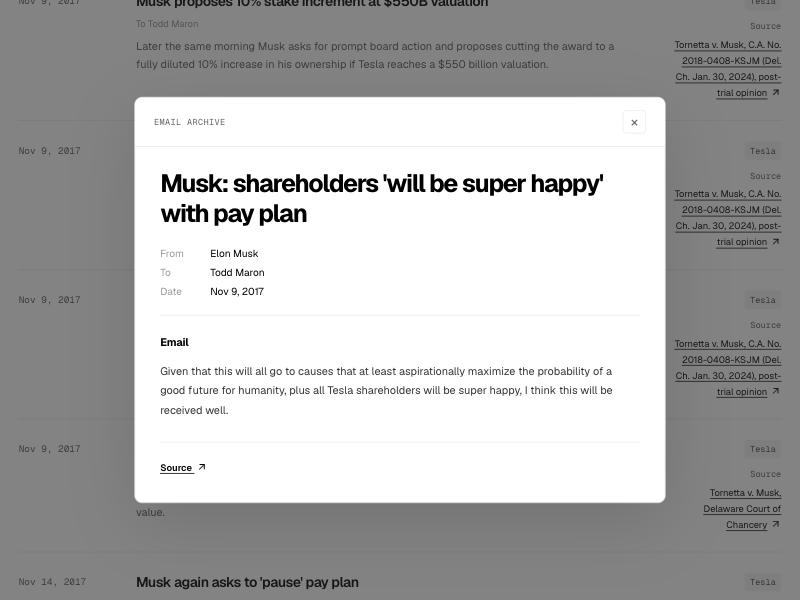
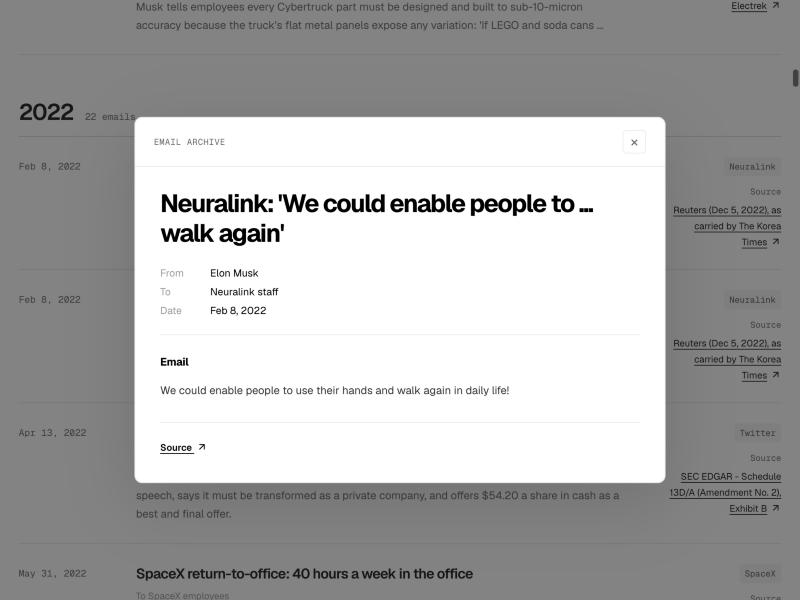
The second, to his Neuralink staff in 2022, came minutes after he forwarded them news of a paralyzed man who had walked again.
"We could enable people to use their hands and walk again in daily life!"
Elon Musk to Neuralink staff, February 2022. Reported by Reuters.
Read the money cynically and you have a point. His formal giving is thin. The Musk Foundation sits on about 14 billion dollars, and by the law's own yardstick it falls short.
Loud pledges on world hunger and Flint water never arrived as cash. Elon Musk is an unremarkable donor compared to his peers.
So, what makes Elon Musk the greatest philanthropist now?
Pick the old yardstick, dollars given away as a share of wealth, and Musk loses to Gates, to Buffett, to MacKenzie Scott. Pick a newer one, human harm prevented each year by something that pays for itself and keeps running, and the order flips.
Carnegie's libraries still stand. The real question for this decade is whether a satellite over a cut off island, a grid that holds after sunset, and a voice given back to a man with ALS belong on the same shelf.
The wall between making money and doing good was poured in a century when doing good was costly. That century is closing. As the cost of building falls to the floor, the only honest reason left to make something that helps no one is that it never occurred to you. Soon that will not be an excuse. It will be a choice, and it will be a strange one.
Philanthropy may just be its oldest meaning, finally cheap enough to live by.
Love of humanity, built into the thing itself, earning enough to last. The surprise is not that someone got there first. It is that the rest of us still call it a paradox.
This is an opinion essay. Figures are drawn from company reports (including Tesla's 2025 Impact Report), NASA cost analysis by Edgar Zapata, Neuralink trial updates, Musk Foundation Form 990 filings, and contemporary news reporting; company estimates are identified as such. The emails come from a public archive, elonmuskmails.com, which sources each message to a court exhibit or a named outlet. Not investment advice.