Key Takeaways
- Every $EAT trade carries a 1 percent fee. One quarter of that fee goes to creators who end hunger.
- Imagine that model on Dogecoin. $1 billion of trading in a day would send $2.5 million to creators that day.
- $EAT is the first token that funds creators to end hunger. The $1 million Creator Fund is open now at fund.eat.ong.
Billions of dollars of tokens trade every day. Almost none of it does anything for anyone outside the trade. EAT was built to change that. All trades fund creators, and those creators feed people.
Imagine if trades mattered
Dogecoin has had many days with more than $1 billion of trading. That volume pays no creator and feeds no one.
Now run the same day through the EAT model:
- $1 billion traded in a day.
- A 1 percent fee is $10 million.
- One quarter goes to creators: $2.5 million, in one day.
- Another quarter goes to hunger-relief charities: $2.5 million more.
That is what it looks like when trades matter. The creators who are ending hunger are the ones who get paid in this model.
This is a comparison, not a forecast. $EAT does not trade at that volume today, and this article says nothing about its price.
The flows

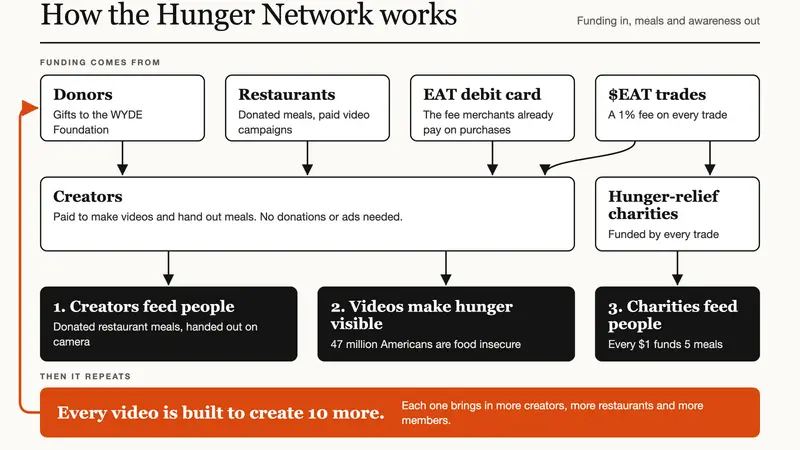
Four sources fund the network:
- $EAT trades. A 1 percent fee on every trade, split into four equal parts on-chain: creators, hunger-relief charities, liquidity and the platform.
- The EAT debit card. The fee merchants already pay on each purchase funds more hunger content.
- Restaurants. They give meals and fund video campaigns.
- Donors. They give to the WYDE Foundation.
Two things come out:
- Creators feed people. They hand out restaurant meals on camera, and the videos make hunger visible. See the first two EAT creator videos.
- Charities feed people. Hunger-relief charities are funded by every trade. Every $1 funds 5 meals.
Then it repeats. Every video is built to create more creators, more restaurants and more members.
A new source of income for creators
Creators earn today from ad share, brand deals and fan payments. All three depend on someone else's budget. Trade fees are different. They arrive with each trade, at any hour, on any day.
Creators are paid for work: videos, challenges and clips that feed people or show how to end hunger. A creator does not need to buy, hold or promote the token. No one donates money to a creator, and no ad runs in front of the video.
The $1 million Creator Fund is open
EAT has set $1 million as the floor. The fund pays for clipping, so one video becomes many, and it grows with each trade.
- Apply at fund.eat.ong.
- EAT reviews applications next week, ahead of the challenges app launch.
- Seats are limited.
People Also Ask
How do creators make money from $EAT trading?
Every $EAT trade carries a 1 percent fee. One quarter of the fee goes to creators. EAT pays creators and clippers for hunger videos, challenges and clips.
How much would creators earn at Dogecoin's volume?
Under the EAT model, $1 billion of trading in a day would send $2.5 million to creators that day. This is a comparison to show how the model works. It is not a forecast for $EAT.
Do creators need to buy or hold $EAT to be paid?
No. Creators are paid for their work. They do not need to buy, hold, trade or promote the token.
Where does the rest of the fee go?
The 1 percent fee is split into four equal parts: creators, hunger-relief charities, liquidity and the platform. Half of the charity part is for Feed the Children.
How do I apply to the Creator Fund?
Apply at fund.eat.ong. Seats are limited, and applications are reviewed next week.
Apply now: fund.eat.ong.